
Stock Options Made Simple: A Beginner’s Walkthrough of Trading Basics

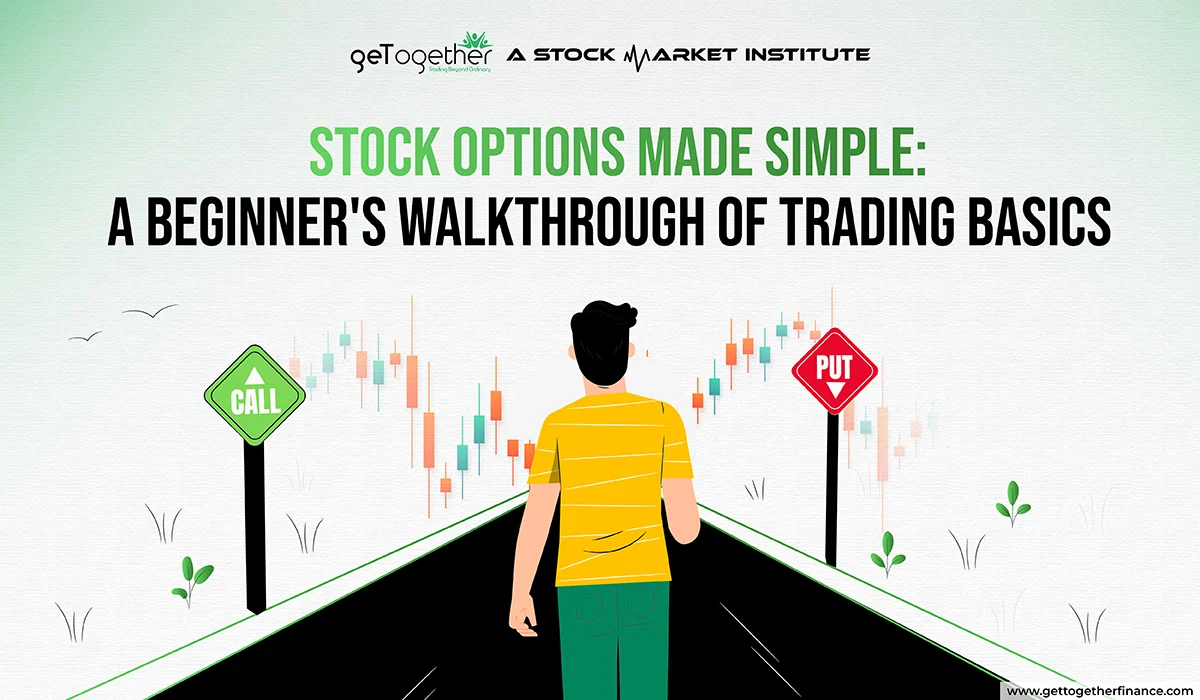
Are you new to the stock market? If so, you must have heard of one of the most popular investment tools – stock options trading. This financial instrument has gained significant traction as it enables investors and traders to diversify their portfolios.
While stock options trading yields considerable profits, investors can end up enduring huge losses if not understood properly. A SEBI report found that 9 of 10 individual traders incurred net losses during FY19-FY22. The average stood at ₹1.1 lakhs during FY22.
This article will discuss the fundamentals of buying options in stock markets and delve into investing jargon around it.
What is Stock Options Trading?

Stock options trading involves buying and selling options contracts. These contracts are associated with an underlying asset, and allow investors to trade a certain volume of that asset at a particular price during a particular date.
The pre-negotiated price is called the strike/exercise price, and the amount you pay upfront for any stock option is called the premium. Additionally, the predetermined deadline on or before which you can trade these assets is called the expiration/maturity date.
The best part about stock options trading is that you do not have to buy or sell assets compulsorily. Instead, it offers you the “right” to trade stock option contracts.
How Does Stock Options Trading Work?

As you dip your toes into options in stock markets, you will find two primary types of stock options: Call options and Put options.
Call Options
A call option lets you purchase stock option contracts at the strike price until the expiration date. Its value increases as the underlying stock price increases. Hence, call options are useful when the markets are bullish. Alternatively, you can sell a call options contract if you reckon the stock price will decline or does not show much movement.
Let’s say ABC’s stock is currently trading at ₹100/share, but you believe it will soar to ₹130/share in the following three months. So, you buy 100 call option contracts for ABC with a strike price of ₹110/share and a maturity date three months from now. To exercise the contract, you only pay a premium of ₹10/share to the person selling them.
If ABC’s stock price surpasses ₹130 within the next three months as expected, you can buy the stock at the lower ₹110 strike price, even though the market price is ₹130. You can then sell the stock immediately at that market price and earn a profit of ₹130-₹110-₹10 = ₹10/share.
Now if ABC’s stock price stays below ₹110, you do not have to use the call option; instead, you only lose the option premium you initially paid, i.e., ₹1000.
Put Options
A put option lets you sell stock option contracts at the strike price until the expiration date. Its value increases as the underlying stock price decreases. Hence, call options are useful when the markets are bearish. Alternatively, you can buy a put options contract if you believe the stock price will increase or does not show much movement.
Let’s say ABC’s stock is trading at ₹100. You think it is overvalued and will drop to ₹75 in the next three months. So, you buy a put option contract with a ₹90/share strike price and a three-month expiration. To exercise the contract, you only pay an option premium of ₹10/share.
If ABC’s stock price drops below ₹75 as you wished, you can sell the stock at the higher ₹90/share strike price, even though the current market price is lower. You can then sell the stock at the higher ₹90 strike price and earn a profit of ₹90-₹75-₹5 = ₹10/share.
If ABC’s stock price remains above ₹75, you do not have to use the put option; instead, you only lose the option premium.
Benefits of Buying Options in Stock Markets
While stock options trading is slightly more complex than stock trading, you can lock in relatively bigger profits if the asset price goes up. That is because you do not have to pay the entire price for the stock in an options contract.
Similarly, stock options trading can reduce your losses if the stock price tilts in the opposite direction than expected for either a put or call. In such cases, you should let the options contract expire. That way, your losses are equal to the premium plus the associated trading fees.
Also Read: Bearish Options Strategies
Things to Know Before Buying Options in Stock Market
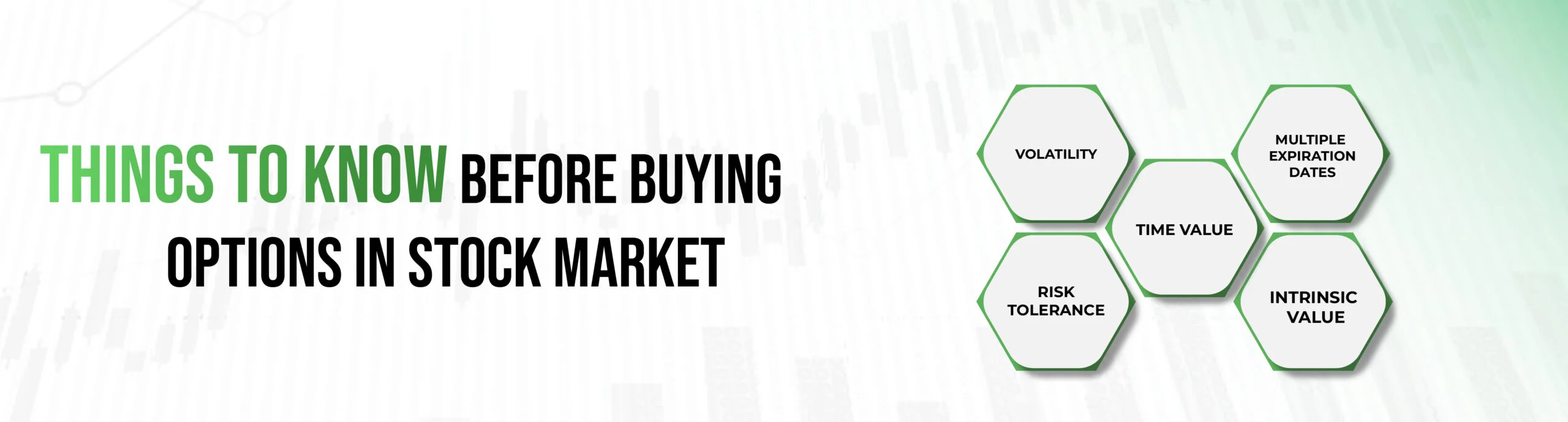
Before picking stocks for options trading, there are multiple factors to consider:
Multiple Expiration Dates
India runs one of the world’s most complex and extensive options markets. In the spot market alone, there are 188 different trading options available, including complex contracts like iron condors, short saddles, and calendar spread. Hence, finding an options contract that suits your needs is relatively seamless.
Intrinsic Value
Intrinsic value is a stock’s worth that is irrelevant to its current market price. Future earnings from the put option, estimated using an options payoff chart, determine an option’s intrinsic value.
Time Value
Time value is the rate of increase of an option’s price as time passes. A call option has more time value than a put option. That is because buyers of a call have more time before they purchase something at the strike price. As such, they have more time to realize their profits from exercising their option before any expiration date rolls around again.
Volatility
Stock options trading is more volatile than traditional stock trading. Indeed, experts reckon that profit potential is maximum in high-volatile stocks.
Stock options trading is ideal for traders who look to stand out by profiting from unpredictable events, such as economic swings or global trends that could trigger price fluctuations until their expiry.
Risk Tolerance
Generally, investors with deep pockets and a high-risk appetite buy/sell stock options. Moreover, this investment strategy involves short-to-medium-term gains. The reduced time window increases the uncertainty pertaining to stock options trading.
Every option strategy has a clear-cut risk/reward profile, so understand it properly. Avoid overcommitting and manage risk through diversification and position sizing.
Trade Stock Options With Confidence
While stock options trading seems quite straightforward and offers greater profit margins, you can slip into trouble if you are a rookie investor. As with any other investment options, better understand what type of stock option you are purchasing. You could lose your hard-earned money if your thesis turns sour.
If possible, use online simulators to get a gist of how stock options trading works before trying the real deal. Whenever you are ready, start small – you can always try more aggressive stock options strategies down the lane. Initially, better focus on some stocks you know well and wager an amount you are comfortable losing.
FAQs
What is futures and options in stock market?
Future contracts obligate traders to buy and sell shares, while options contracts do not come with such obligations. Traders must execute futures trading at the decided date of the contract only, while they can exercise options contracts anytime within the specified date. Furthermore, options contracts charge a premium to traders, while there is no entry fee to exercise futures contracts.
What is options selling in stock market?
How to select stocks for options trading?
1. Choose highly liquid stocks, meaning they have active options markets with tight bid-ask spreads.
2. Volatile stocks have higher options premiums, leading to more significant potential returns.
3. Study the share’s price chart and technical indicators to identify trends, support/resistance levels, and potential entry/exit points.
4. Understand the option Greeks, such as Delta, Gamma, Theta, and Vega, to analyze how changes in the share’s price, time decay, and volatility affect your options positions.
Do stock options expire?
In India, monthly options contracts expire on the last Friday of the month after the closing bell. Weekly options expire every Friday. If the expiry date coincides with a bank/market holiday, the contracts expire a day before the original date.
What is options trading in stock market?
What does it mean to exercise stock options?
What is exercise price of stock options?
Are company stock options taxable?
Besides, any capital gains arising from selling shares purchased through ESOPs are subject to capital gains tax. For instance, if employees sell the shares within one year (two years in case of unlisted stocks) of the exercise date, they attract short-term capital gains tax at their applicable tax rate.
Can you sell a call option without owning the stock?
Is it better to take RSU or stock options?
However, RSUs deliver lesser returns than ESOPs. That is because employees buy stock options at a lower strike. So, if the stock price increases significantly, the potential for profit can be substantial.
What is vested stock option?
How are stock options priced?
How to select option stock?
What happens to options if a stock is delisted?
If the stock is delisted and options remain unexercised, the options will generally expire according to their original expiration dates. Unexercised options eventually become worthless at expiration.
What is a cliff period on stock options?
What is a stock option grant?
What is IV in stock options?
Where do stock options come from?
How to calculate stock option value?
How to pick stocks for options trading?
How to trade stock options?
1. Learn key concepts, including call and put options, strike prices, expiration dates, and options premiums.
2. Open a trading account with a brokerage company providing options trading services.
3. Determine your risk tolerance and trading goals.
4. Consider factors like liquidity, implied volatility, and market conditions while choosing suitable options contracts.
5. Create a trading strategy with clear entry/exit points and risk management guidelines.
6. Specify whether you are buying (going long) or selling (writing) options contracts.
7. After executing trades, review your performance, analyze your trading decisions, and learn from your successes and mistakes.